February 22, 2009
Review: Turbine
 Wind farms seem like a really good idea. They use wind (a good thing) and they’re a farm (another good thing) so anyone who complains about it should just shut up and think of the polar bears, right?
Except it’s a bit different when those 111-metre-high towers are now all you can see out the windows of your house and you’re worried about the effect the vibrations from the turbine will have on your dog.
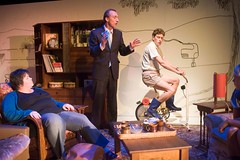
This tension between turbine-loving power companies and the people who live in the area of a planned wind turbine installation is at the core of Turbine, the new SEEyD Theatre Company production at Downstage.
More after the jump…
The story focuses on the Gusten family – widow Gail, daughter Susan and autistic son Ariel. They’re frequently visited by power company rep Mark, who’s kind enough to come over on a Sunday.
The timeline of the play is a little tricky, jumping backwards and forwards and with a few slightly surreal break-aways. But it’s never confusing, thanks to the skilful lighting and sound design.
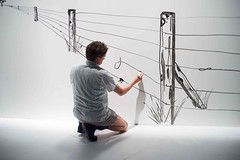 I was really impressed with the set design (courtesy of co-writer, director and performer Tim Spite). The backdrop is a giant whiteboard surface with a basic landscape sketched on it. Throughout the play, the actors add or erase bits to it as the story progresses – suddenly the hills have turbines atop them, but there’s also a toaster getting power.
Wait, does it all sound really serious? Cos the play was really funny. There’s a nice mix of physical humour, wit and a little bit of fourth-wall-breaking. It took a while for the audience to warm up, but once things got going it was really enjoyable.
The play toys with the idea of being a “bad future”, where the turbines drone ominously in the background; and a “good future”, where the the wind farm has brought much happiness, but ultimately the story comes down to the very human element of the Gusten family.
Turbine is playing at Downstage until 7 March. (You should go and see it, I reckon.)
Comments are closed.