Review: RNZB’s Macbeth
Review contains major spoilers for the RNZB’s Macbeth – the only reason I’m spoiler warning a 400 year old story based loosely off an 1000 year old historical figure is that the RNZB does include some changes in its staging that are more so implied in the text, and there’s also some things you want to see live rather than spoiled in a review.
The Royal New Zealand Ballet (co-produced with West Australian Ballet) kicks off its 2026 season with royal escapades turned stylish political horrors in a performance of Macbeth utterly trenchant for our times.
You know the themes of Macbeth; witches spur a desire in Macbeth, and his ambition (and that of his wife) leads him towards murder, and eventually his downfall, in pursuit of the throne.
Here, Macbeth (Branden Reiners) is a political prodigy, spurred on by his wife Lady Macbeth (Ana Gallardo Lobania) and three influencers/media personalities (the aforementioned witches – Kirby Selchow, Ruby Ryburn and Shaun James Kelly) to kill Duncan (Laurynas Vėjalis) and commit a variety of other murders to find his way to the top, before his reign of terror is finally ended by Macduff (Zacharie Dun).
For the most part, this modernisation (dramaturgy by Ruth Little) works excellently well, casting us back to early 2000s vibes of Wall Street elite (plus iPhones), glitterati, where actions don’t have consequences and life’s just one big party.
A prescient take, considering the times we find ourselves in.
The modernisation works to a point, changing twilight stabbings to out-in-the-open poisonings, an assassination at a bar, a formerly off-script suicide staged in a bath right in front of us; secrets made flesh for the viewing audience in a way they just aren’t in the original text, to its benefit. Business as usual the day after the death of the head of a company? Sounds like a typical 2026 Thursday,
I would perhaps question the death of Macduff’s family – which is implied via fiery projection and seems at odds with what’s printed in the programme, though I do commend not actually showing it - the historical precedent stating as much.
Alice Topp’s utterly inspired choreography is a sight to behold. I know Macbeth very well, have seen more than enough playings, and it’s impressive how distinctly some of the key pieces of verse have been translated to the dance; what we know as ballet colliding slickly with modern dance and various other styles to create something entirely unique.
Lady Macbeth’s “Out, damned spot!” becomes a striking moment of utter despondence, held high on the upper level of the set, and culminates with her downing pills and pouring wine over her head as she settles into her bath to die. A pivotal effort from Gallardo Lobania, taking a role that’s traditionally incredibly hard to find within its ambition and its grief, and utterly flourishing within it.
The sizzling, spicy toxicity between Macbeth and Lady Macbeth is enough to melt our ice creams in the auditorium, every duet between the pair an active struggle for power, two people never quite in the same mind as they leap, hold and eventually crumble apart.
What’s more is that Macbeth and Banquo (Kihiro Kusukami) – his long-time friend, in the case I’m guessing main confidant – have about as many duets as M/LM, the pair initially seeming to dance as ambition of a lighter, less pressured sort before they slip away into toxicity too.
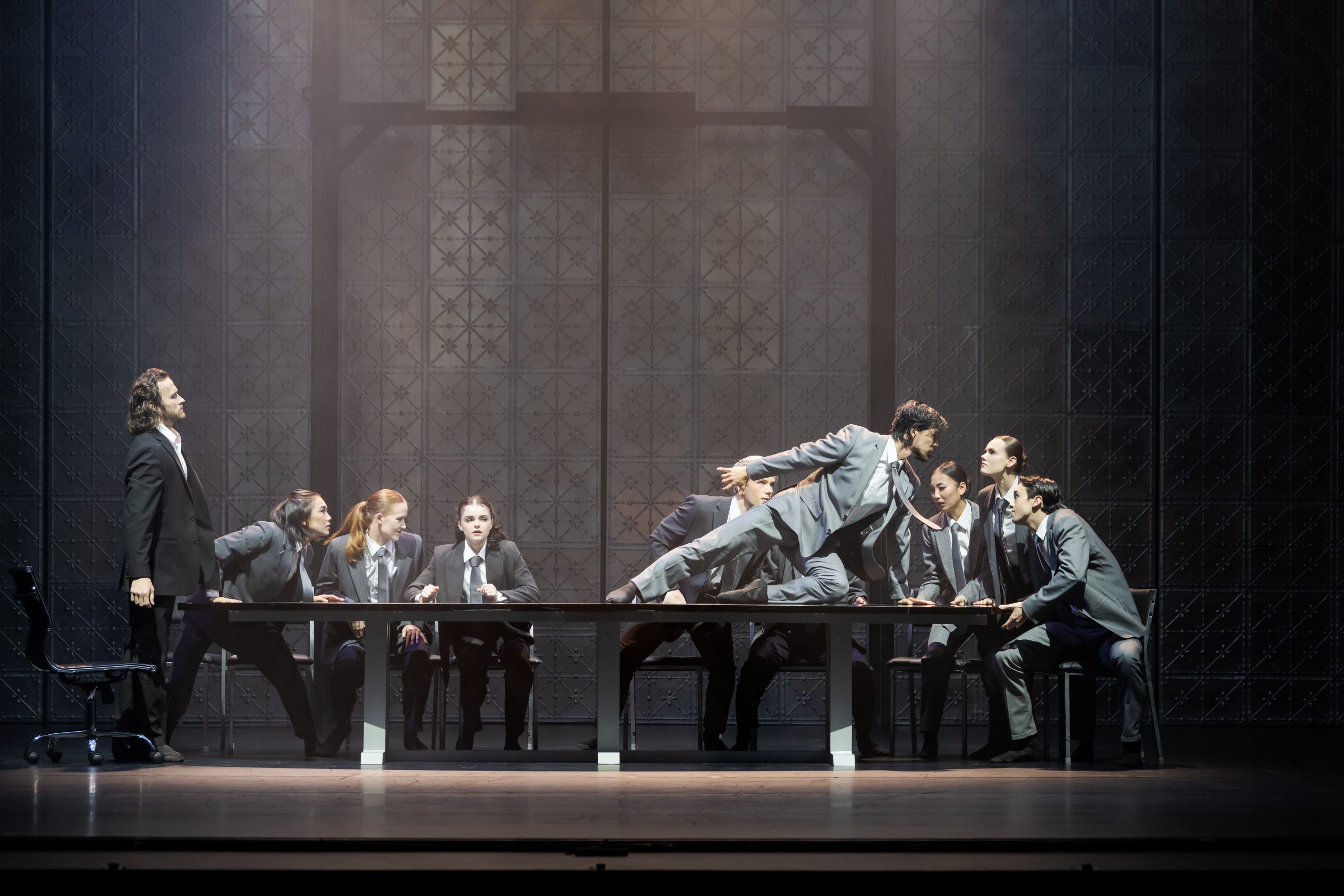
The ensemble, too, is given a lot to do; Macbeth and his fellow politicians fighting for control on a long table at the top of the show, as well as several group numbers that inspire thoughts of The Great Gatsby, and all are performed with the flair you’d expect, not a hair out of place during very technically complicated pieces.
The most impressive staging of a pivotal moment in the work comes with Banquo appearing as a ghost to Macbeth. There’s a variety of ways to portray ghosts on stage, but during a banquet; the long table at the back of the stage clothed in bright red, successful patrons celebrating their wins, Banquo drags himself forth from within the table itself, and he and Macbeth struggle for power in a dance that’s a visceral mirror to those previous, before Macbeth tumbles away, both he and his wife broken, at the end.
I’d also note Banquo’s death itself, staged in a lowered set, giving the vibes of an underground bar, which involves stage combat interwoven within the dance and an actively impressively-staged death as it concludes.
To leave out discussion of the show’s production design would feel utterly bereft. Both the set and lighting design (Jon Buswell) are a spectacle, the stage divided into an upper and lower level, the upper level rising up and down and then tipping at one point to create three distinct playing spaces, with nothing wasted. Industrial, several shades of metal, with bloodied/rusted remnants appearing in the final scene, it truly gives the experience of a cutthroat, unprotected industry.
The costumes (Alesia Jelbart), too, ere on the side of minimalist, all but three predominantly dressed in shades of black, white or grey, with the three influencers dressed in red and green visibly the centre of this tortured world, as much as others try to reach for it.
You can’t talk about this show without mentioning its score (Christopher Gordon, conducted by Hamish McKeith, performed by the NZSO), which wanders into the realm of rock opera at points, Macbeth’s struggle for power literally physically felt in the weight of the music; eerie and visceral string work that haunts the narrative, whilst darting around 40s big band and 70s soul for some of the group scenes.
Never have I wanted a RNZB score to be purchasable at home more than this one; what a treat.
A denouement to remember, Macbeth’s final moments involve him, broken, at the end of his rope, literally climbing up a sloped wall to be put out of his misery, blood slipping down the slope behind him as he falls, a rightful end that is as physically complex as it is incredible to watch. What a show.
Visually and performatively a spectacle, Macbeth lives up to the hype of its stunning production imagery, and sizzles with all the toxic spice you’d hope for. Run, don’t walk to this staging, on across the country now.