Notional Significance: Isthmus
From the start, it was seen as treacherous: even taniwha would have been advised to steer clear. When the first streets cut across the sandhills, to European eyes it was a useless stretch of unstable dunes and swampland, low on the list of exploitation priorities. Pakeha brought vermin: generations of children knew Tirangi Road as “Rabbit Hill”, and until very recently the roundabouts of Cobham Drive were well-known warrens. There were reclamations (I’m walking a couple of blocks out from the original shore), bulldozings (for Exhibition and airport), runway extensions and military target practice. The flat, wide, featureless expanse of Kilbirnie/Rongotai is a convenient fiction conjured into commercial reality.
Land as machine, the engine of the economy. From the sky, roundabouts are gears, the runway is a steel truss, and arterial roads snake like hydraulic cables, pumping workers through the system. From the ground, the machine looks less well-oiled (stained concrete, burnt-out corrugate), but there’s something definitely unheimlich about this artificial earth: neither nature nor urbanity; not suburbia yet not quite edgelands. Even the emerging stadium revels in engineering imagery — aerofoil, air filter, turbine — and it seems ready to turn if the wind picks up, grinding out electricity more efficiently than Andrew Drummond’s vandal-magnet Tower of the Winds nearby.
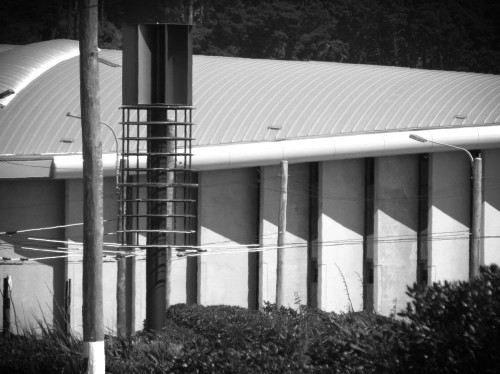
It’s another reminder of transience, of the tendency for meanings and objects to slip and slide along the spine of the highway. For St Pat’s College was once across the road from the Basin Reserve, where it stood in the way of the 1960s motorway extension. Deals were done, and the boys trekked east. Exile goes both ways: when the Centennial Exhibition staggered to its death, Kupe & Co were shipped out to the railway station before assuming their waterfront vigil, and the fountain’s hidden engines were trucked up to Kelburn Park. Even the airport was once lost to the isthmus, closing in 1947, and operations shifted to Paraparaumu until Rongotai could be reborn as a proper international airport (or at least a modest imitation thereof).
More intersections, more playing fields, more traffic. The dairy on the corner is boarded up, upper windows obscured by a billboard: a woman, grinning, glowing, clutching the ubiquitous Pump bottle. “Feeling good/is a choice…//habit, health, happiness”. We used to walk to the dairy; now we drive to the gym, sitting at the lights while airbrushed toothy models tell us about choice.
Ruahine St begins as a rude cut through hard yellow earth. Someone (presumably “Steve”) has cut a more tender inscription — STEVE LOVES YOU <3 — though the object of his affections has been washed and blown away. Rough paths lead invitingly into the cool, piney Town Belt, but the sun hammers down on the burgeoning traffic, and onto the patchy green slopes of Hataitai Park. Born from the guts of the Mt Vic tunnel — and on at least one occasion, the body of a murder victim — the park feels off-kilter, left-over, unpeopled.
The land beside the road has a designation, allowing for two more lanes. It will slice further into the awkward slope of the park (clearly not natural, but not quite flat enough to be useful). And in places, it might crib a little more space towards the eastern houses, erasing the last vestige of the stream (little more than a ditch, signaled by toxic lilies and the barest hint of a trickle) that runs between the road and Roger Walker’s Park Mews. In its current white and blue livery, there’s less to justify the predictable “Noddy House” epithet, and perhaps just a hint of Neuwanschtein with its spires and embrasures. Or maybe it’s the sun and the fumes that are giving me a touch of Mad Prince Ludwig.
The first pedestrian bridge of the journey, rearing up on spindly wooden legs across a bend in the highway, signals the approach to the tunnel. Philosophical graffiti (COGITO ERGO SUM, FREE-DOM) tease the mind, but the body is more interested in escaping the heat and seeking sugary snacks among the Hataitai shops. The French Bakery, though perhaps lacking in Gallic verisimilitude, delivers admirably. I eat among the pohutukawa shade that stretches between public toilets, kindergarten, Town Belt and the highway’s urgent curve. An acquaintance (a walking advocate, if I were looking for irony) drives past — I wave, acknowledging the archetypal “small Wellington” moment — and then I’m ready to approach the roaring portal.
Thanks Alf. I’ll forever be humming Ride of the Valkyries as I go past the Noddy House.
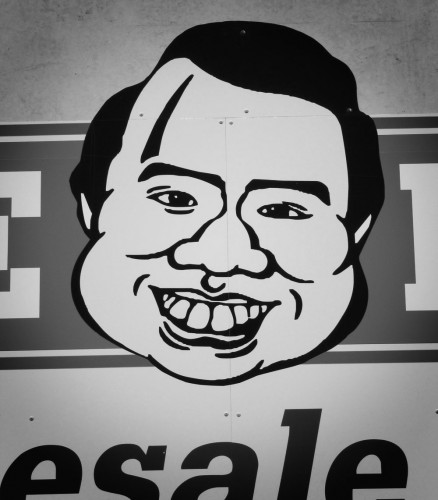
When i think of Uncle Bill and his wholesale Club, I’m thinking more of the mere, or patu, with which to club Uncle Bill himself. The architecture at that point is banal – the signage tips it over into true awfulness. Somehow, the two of them together aggravate my soulfullness…
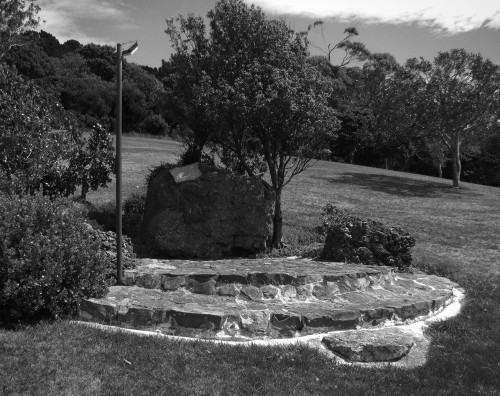
The war memorial commemorates the 19th Infantry Battalion from Wellington and yes, there was a military camp in the park (up where the tennis courts/rugby field are) during WW2, so the memorial does have some local significance. The “spindly shrubs” were meant to represent trees from the areas where the soldiers fought.