Notional Significance: Skyway
[See all Notional Significance posts]
The stretch of motorway that leaps out from the bluff was known in the Sixties as the “Kaiwarra-Thorndon Skyway”, incongruously combining the Jetsonian optimism of the term “skyway” with a mangled contraction of “Kaiwharawhara” that today would only be used by Pakeha blokes of a certain age. Both the skyway and the land it avoids are human constructs: one a wriggling, restless path through unencumbered air, the other an intentionally featureless reclamation. From up on the bluff the land looks temporary, provisional; a jumbled flotsam of shipping containers, Nissen huts, skips and chain-link that might has well have been deposited by a receding tide.
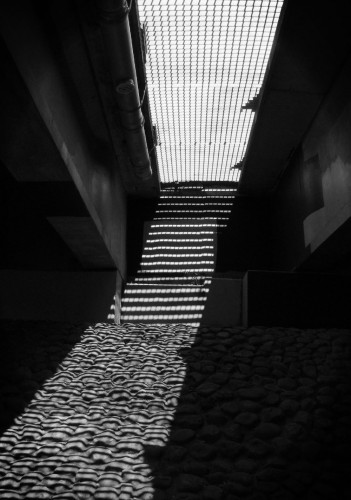
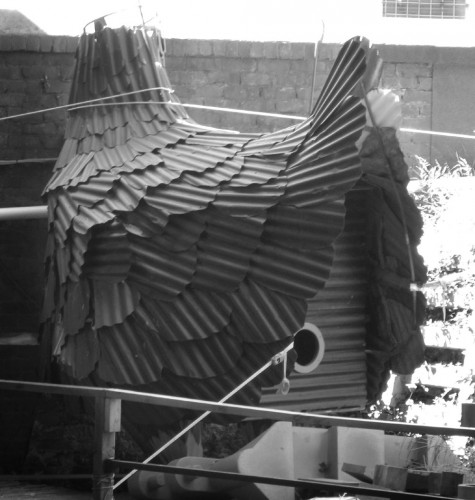
On a more typical Wellington day, the space beneath the flyover would feel as these spaces usually do: dank, oppressed, musty and grim. But in today’s heat the sub-highway air is pleasantly cool beneath the dark concrete ceiling, and the web forge between the carriageways casts a distorted grid of shadows across the cobbled incline, like the ripples of a stream. The space below is an electric-fence sanctuary, a temporary home to brash orange machinery, roadside barriers and fencing supplies, and also, bizarrely, a giant headless chicken, fashioned from corrugated iron and with a neon-bright tube projecting from its arse. Perched between brick and crib walls, trussed up with cables, it’s going nowhere.
I’d intended to continue straight down beneath the elevated highway to Thorndon Quay, but a bloom of graffiti and another hand-beaten path tempt me away, up the other bank to a sliver of scrub, wedged between the Armco and the rear gardens of Tinakori Rd. I’m just metres from the back of Katherine Mansfield’s birthplace, but that’s a well-trodden heritage-industry path, so instead I pick my way through weeds and broken glass around the heavily-tagged rear walls of a red-brick bunker that turns out to be a bridge club. Past a couple of Tinakori houses, and I’m back at the cliff’s edge, approaching the distinctive white wooden railings that indicate a steep pedestrian shortcut down to the Quay.
In one sense, I have reached the end of Wellington: this was the northern edge of the Mein Smith map; beyond here there was nothing but the harbour’s breaking waves and a treacherous coastal route towards the hinterland. It was also a site of multiple significance to Maori, near the Pa-kuao kainga, the Whakahikuwai and Wai-paekaka streams, and the start of the Owhariu-Thorndon track, which wound up the the hill through what are now the suburbs of Wadestown and Crofton Downs. But this is one place where I can’t dodge the Mansfield connection, given that it’s the site for the oft-quoted excerpt from The Wind Blows:
“They cannot walk fast enough. Their heads bent, their legs just touching, they stride like one eager person through the town, down the asphalt zigzag where the fennel grows wild, and on to the esplanade. It is dusky — just getting dusky. The wind is so strong that they have to fight their way through it, rocking like two old drunkards. All the poor little pahutukawas [sic] on the esplanade are bent to the ground.”
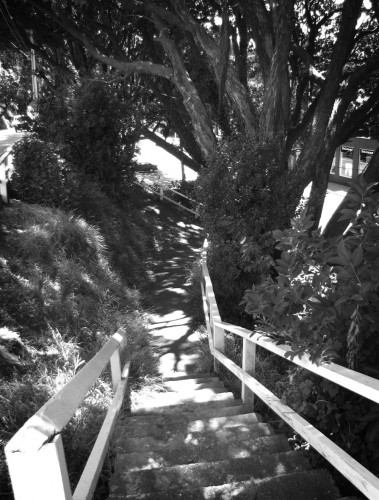
It’s a recognisably Wellington scene, but what strikes me is that the pohutukawa are now vast, intransigent, multi-trunked beasts, and that reference to them as “poor little” saplings emphasises their own status as relatively recent immigrants to this harbour. Under their deepening shade, I zig down the zag and out onto the former esplanade, now the landlocked Thorndon Quay. I have to curve away from the highway, around former woolstores (now a sedate crypto-mall for house-proud middle-class design addicts, complete with European furniture showrooms, architects’ studios and a bijoux French market), but then I stumble across an almost-hidden subway, sliding underground towards the skyway. Signs tell me that I’m not welcome, but there is no gate, so I decide to investigate.
The underpass is adequately lit, but reeks of damp concrete and unidentified petrochemicals. Pipes and cables march neatly across the walls, and white rectangles mark the places where graffiti has been freshly buffed from the stippled plaster. The tunnel bends right, slopes up, and deposits me among a tangle of rail lines, the motorway high above. Gravel, peeling paint, great slow fans turning above concrete sheds. A train trundles past, Sunday passengers heading home from a shopping trip to town or looking forward to an afternoon at the beach. It’s the first of many entanglements between the railway and the Road of National Significance: their paths and histories are inextricably intertwined, and no matter how much NZTA and their master want to downplay the significance of rail transport, its importance to Wellington and the region is undeniable. It’s a Railway of Local, Regional and National Significance.
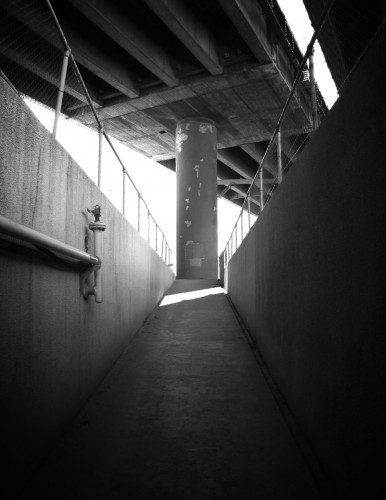
I look up to the hefty, chunkily-coffered underside of the motorway and the rude stumpy legs that support it. It may have been regarded as an engineering marvel at the time, but now it lacks the finesse, the economy of means and above all the aspiration to weightlessness that I would associate with the word “skyway”. Photos of the young motorway tell a different story: Einhorn’s original design had delicately tapered stanchions beneath the lightweight on-ramps, and even the simple cylindrical pillars beneath the main decks were fluted, as a faint nod to Ionic columns. Now they are all graceless heffalumps, presumably encased and entombed after a later strengthening exercise. No doubt this was a sensible measure, but one performed with such visionless pragmatism that it reminds me that now engineering is rarely a noble science; more a branch of accounting.
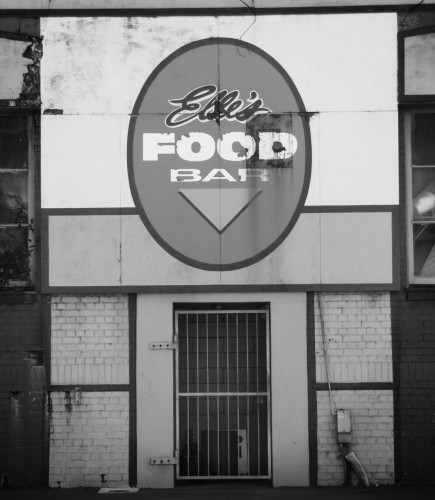
I could trespass further among the marshaling yards, but instead I return to the main road, which now becomes the Hutt Rd. The businesses are mostly matter-of-fact, though the former Flamingo and Elle’s Food Bar offer faded glories in shattered neon and overoptimistic pastels. Open-air stacks of pipes and landscaping materials (Otago Coloured, Bark Nuggets, Moonfleck Pebbles — the raw stuff of the earth gathered, filtered and poeticised for consumption) show that this place is not only dominated by the presence of infrastructure, but also offers the promise of new infrastructure. Gun shops, panelbeaters, rental cars and defunct brothels: the business of edges and the edge of business. For such a no-nonsense place, the names are exotic and almost mediaeval. Nikau Palmatum, Cannibal Creations, the majestic Kings of Storage and Joinery, Salamander Restoration. The next time my salamander is feeling jaded, I will know where to bring it for some recuperative care.
Next I negotiate a landscape of overbridges, their undersides a concrete forest of slender square columns and flattened arches. This is an earlier wave of infrastructure, a remnant of the patriotic modernisation binge that led up to the 1940 Centennial Exhibition, and while it would be a stretch to call it “elegant”, there’s a Piranesian depth to the layered arches that brings a grim richness to the journey. This is also a place of connections: the Johnsonville line slinking overhead towards its first tunnel; the gateway to the ferry terminal; links through space and time to the relics of the Exhibition, dispersed from Rongotai to Kelburn, the waterfront and further.
In the shade of the last overbridge, I pause to reapply sunscreen, which has been sluicing off my reddening skin in the late summer heat. As soon as I stop, I am hailed by a half-familiar figure: it’s an acquaintance of mine, accompanied by out-of-town visitors on a perverse shopping trip through this dusty grey world. After exchanging pleasantries and expressions of surprise, one of his companions asks if it would be rude if she could ask for some of my sunscreen. My friend laughs and says “You’re in New Zealand now: sunscreen, beer and salty snacks are all regarded as common property.” I concur, and after we’ve shared brief conversation and chemical precautions, I leave behind this very Wellington moment and strike out for Kaiwharawhara.
The Map of Notional Significance has been updated.
Sometimes I’d hear train conductors say “Kaiworra”, as part of the “Anyone for Kaiworra or Now-ronga?” call for Hutt-to-city passengers. Occasionally a conductor would pronounce Kaiwharawhara and Ngauranga perfectly, including the initial ng in Ngauranga which my Pakeha mouth turns into a n.
Well done on exploring the subway. I used to see the other end from the train and wonder where it led. I guess it’s a way for rail workers to get from Thorndon Quay to the yards without having to cross the tracks. Were there train offices on Thorndon Quay or some other work-related reason for them to need to get there from the train yards?
Hi Robyn,
Can you fix the link for the map? It’s got a couple extra characters buried within the URL.
I don’t know why that keeps happening, but I’ve fixed it.
Oh weird, I thought I’d checked it. Thanks for fixing it, Keith!
I think that a couple of the buildings near the Hutt Rd side of the tunnel may be rail-related, and there may be some employee parking there, but otherwise it might just be a helpful shortcut to get to the street and bus stops.
“Occasionally a conductor would pronounce Kaiwharawhara and Ngauranga perfectly, including the initial ng in Ngauranga which my Pakeha mouth turns into a n.”
If it helps, try saying “fucking Oh-rung-uh” a few times, then drop the “fucki”.
It helps to say “fucking Boh Runga” a few times. Not with pronounciation, just in general.