New-ish at the Movies: World War Z, After Earth and The Hunt

Bloodless zombies would appear to be that latest trend if April’s Warm Bodies and this week’s World War Z are anything to go by. No blood means studios get a lower censorship classification and – hopefully – a bigger audience. But the absence of viscera also appears to bring with it a loss of metaphoric power. These zombies don’t mean anything very much; they certainly don’t have anything to say about the world we inhabit, or the fears we share. They are vehicles for jumps, scares and gotcha moments (or in the case of Warm Bodies, not even that).
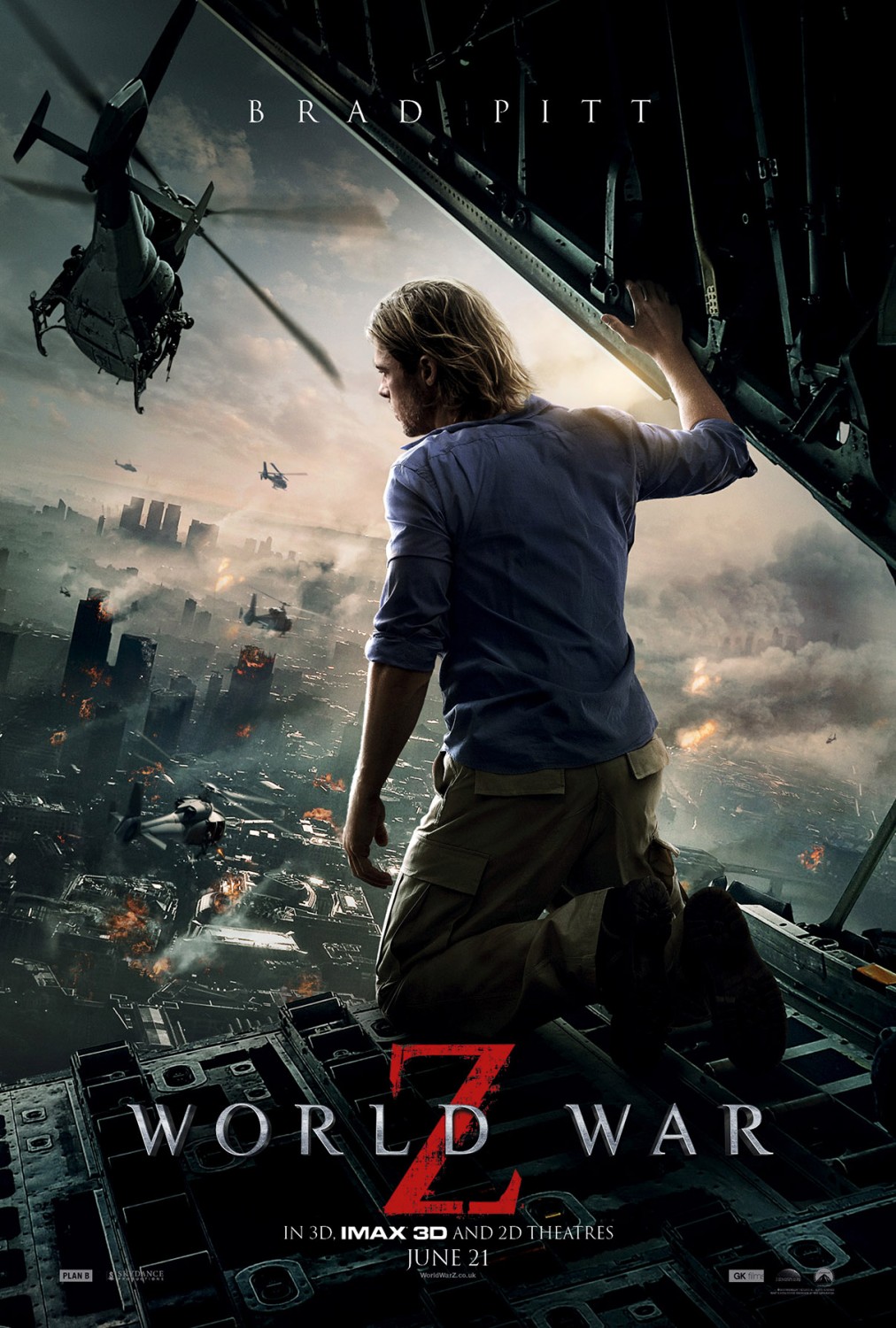 In World War Z, co-producer Brad Pitt plays Gerry Lane, not a Beatles song but a disillusioned former UN troubleshooter trying to start a quiet life with his young family in Philadelphia. A rapidly spreading outbreak of a mystery rabies-like disease turns his – and everyone else’s – life on its head. In a matter of seconds the bite victims become almost unstoppable predators, hunting the healthy in growing packs.
[pullquote]The Hunt felt like a beat-up in more ways than one[/pullquote] Lane and his family are evacuated to an aircraft carrier where the last remaining evidence of authority attempts to restore order. There he unwillingly submits to his old boss (Fana Mokoena) and agrees to help trace the source of the disease and maybe find a cure. With the help of a handful of Navy SEALS and a bright young endocrinologist (Elyes Gabel) he travels to South Korea where the first reports of the outbreak only to find on his travels that things are far worse than anyone can imagine.
I haven’t read the successful book that World War Z was – apparently very loosely – based on and I’m not much interested in the evidently troubled production history that required much reshooting. What I can report is that the set-pieces are impressive in scale and the vision of civilisation’s rapid ruination is more effective than almost every other CGI-disaster movie of recent times.
Pitt, himself, is a solid lead, coming in to his own in the final act – a surprisingly low-key and personal battle to save the planet from a bunch of very British-looking zombie scientists: white coats, crooked teeth, pallid skin; you have to look pretty close to confirm that they do, actually, want to eat you and are not just on their way out the back for a smoke.
But Paramount Pictures spent upwards of $200 million on WWZ and to what end? It’s effective enough but entirely lacking in subtext. I can’t imagine I’ll be remembering it for long and I’m not in any hurry to watch it again.
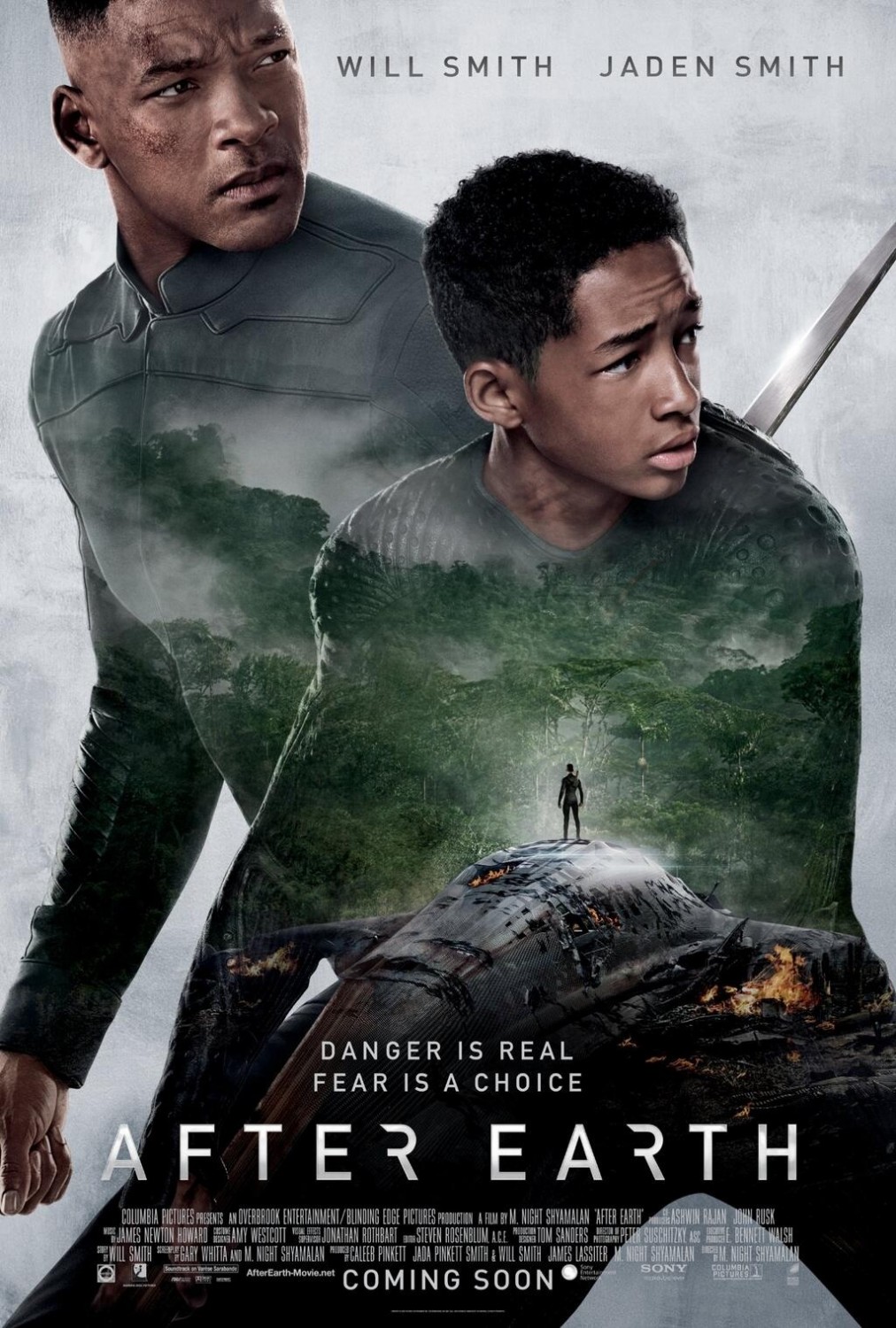 The same is true for M. Night Shyamalan’s After Earth, a science fiction vehicle for the budding career of Will Smith’s son Jaden (The Karate Kid). I can’t imagine ever watching it again, found most of it laughable while I was watching it, can’t really recommend it as entertainment, but – you know – it did try and be about something, even if that something is readily decoded as an advert for the values of Scientology.
I tried to put that knowledge out of my mind while watching the tale of young Jaden learning to bond with his wounded father (Will Smith) and overcome his fear as he locates the special interstellar beacon (shaped like a pizza cutter) that will bring a rescue party and save them both from an alien creature genetically engineered to smell fear – although not engineered to have particularly impressive eyesight.
Taken at face value, After Earth is a flawed attempt at a teen-centred adventure, featuring family values and derring-do. The problem, though, is that you can’t really take it at face value, once you know what’s being propagandised.
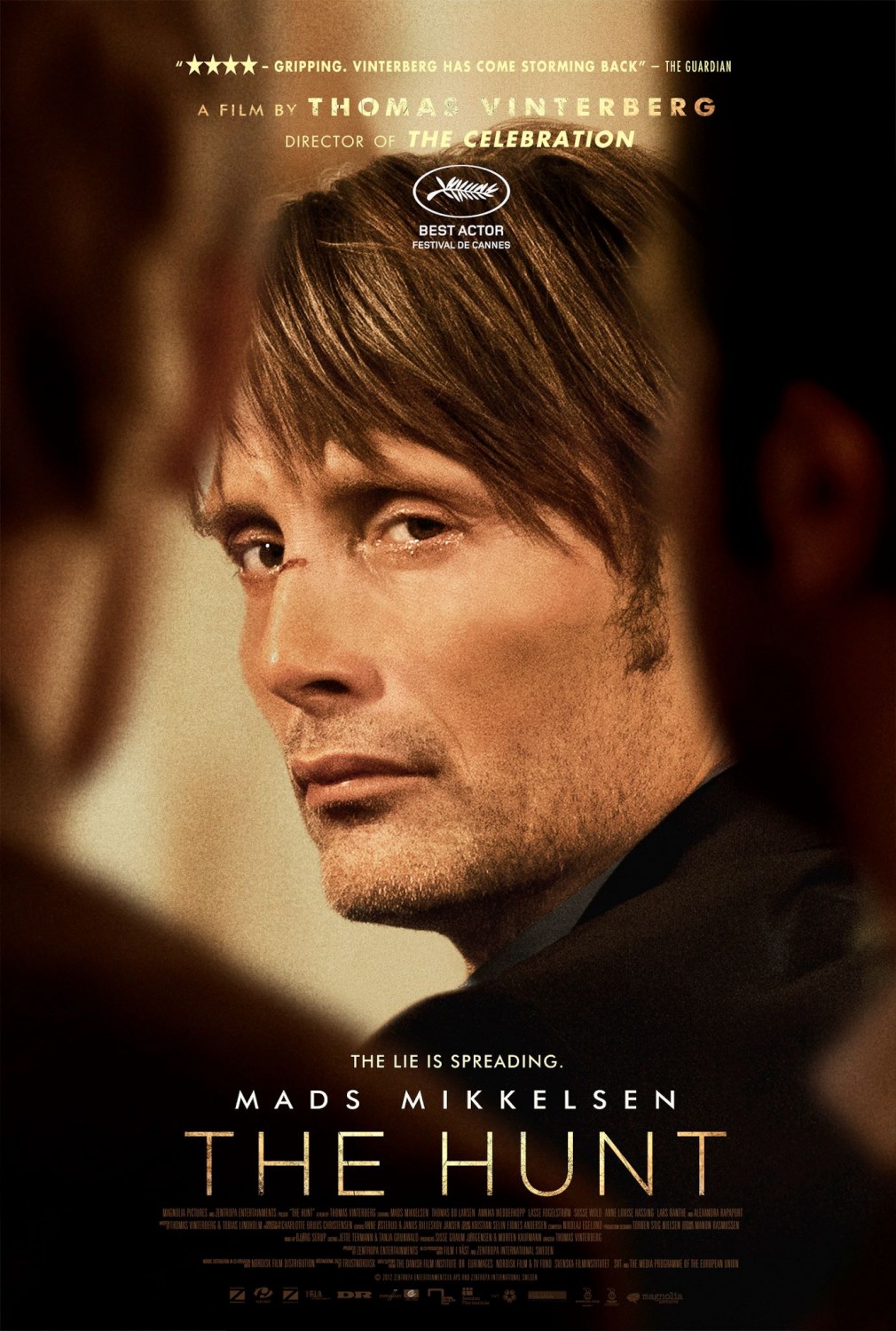 In The Hunt, the great Danish actor Mads Mikkelsen plays a small town kindergarten teacher. This, in itself, takes some getting used to, as he is better known for portraying the tormented or the demented in films such as Pusher and Casino Royale. His character, Lucas, is a gentle man, the kind that should be teaching our littlies. He’s divorced, a little lonely, but quiet and decent. The kids adore him.
His life unravels, though, the moment one of the children – daughter of his best friend and hunting buddy Tio (Thomas Bo Larsen) – unwittingly accuses him of misbehaviour and the leading questions from an inexperienced principal dig Lucas a hole that his honesty and good heart can’t get him out of.
The community turns on him and he loses his friends, his job and – nearly – his son. Beaten up and ostracised, there would seem to be no way out for Lucas, whose life has been ruined by a narrow-minded witch hunt propelled by gossip, fear and ignorance.
Except, all of this might easily have been solved in reel one had anyone – even Lucas himself – used basic common sense and exercised some self-protection. There’s no sign of lawyers, investigating authorities or social workers and the film makes it seem as if the village elders are the only law.
This might have worked better if the film was set in more innocent or naïve times – like the early 1990s of the Peter Ellis case in Christchurch – but it seems unfathomable to me that a male kindergarten teacher in this day and age wouldn’t know how to protect himself from this kind of accusation.
The Hunt is a powerful story, and director Thomas Vinterberg collaborates with Mikkelsen to deliver some electric scenes, but it felt like a beat-up in more ways than one.
[Portions of this review first appeared in Wellington’s FishHead magazine.]
Celebrities are captured by their confessionals and are enslaved because the cult has been known to use your confessionals in law suits against you if you are declared and SP.
All the hidden secrets of Scientology are exposed here.
http://theronbothunter.wordpress.com/2013/03/01/every-fraud-scam-dirty-trick-ttreason-and-crime-by-scientology-exposed/
THE RONBOT HUNTER
ALL RIGHTS RESERVED
http://theronbothunter.wordpress.com/2013/04/04/advanced-self-healing-methods-and-formulas-of-the-patriot-network/
Claiming After Earth has some kind of Scientology message would be like claiming Moby Dick is an ad for the Quakers. It is cheap shot at a religion for who knows what reason. Perhaps it is because Scientology has now reached the point of being a buzzword within popular culture and along with that unjustified ridicule by some who are too lazy to find what it is really about. It is easy to ridicule and to accept rumour (such as the commenter prior to this). Far harder to look for oneself what this new religious philosophy is all about. So for the more discerning, the journey starts here: http://www.scientology.org
I just saw WWZ and I can confirm that it is a deeply silly movie
Apparently a C130 transport plane can take off from the deck of an aircraft carrier -
very, very silly.
World War Z Vs After Earth
Here is yet another duel between 2 apocalyptic films, World War Z and After Earth. A true battle between titans as each film has its own highlights and its own ups and downs. This time however, we’re letting you, the viewer, decide on which you like best and which you think is the best post-apocalyptic film.
http://www.barmybattles.com/2013/06/26/world-war-z-vs-after-earth/
Whoops, a mea culpa is in order – apparently a C130 can take off from an aircraft carrier with a jet-assisted take-off – disposable rockets that fall off.
At any rate, this film shows the re-writes pretty badly – Brad’s character running about trying to save his family got so tedious that I started wincing in sympathy for the actress who played his wife given such a shit role.
The pro-Israel section dropped in looked clunky and laboured – “look- the wall is saving us!” and the Pepsi product placement near the end was to be expected but yeah, it’s a silly and still pretty scary spectacle redeemed slightly by the last third with a stupid denoument
TL;DR- Big screen fodder, leave brain at home