Review: The Undertow
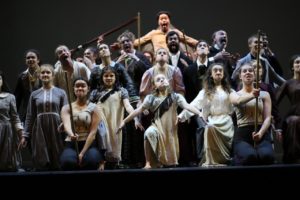
The Undertow is a massive theatrical epic presented by 35 performers from Te Rākau Theatre. Written by Helen Pearse-Otene and directed by Jim Moriarty it follows the story of seven generations of Wellingtonians – Māori and Pākehā – as they carve out a life in Ōwhiro. Each of the four plays explores the experience of the individual while setting it against our wider history. They are being performed two at a time in the weekday evenings, while on Saturdays you can see them all in a theatrical marathon. I’ll add some content warnings (after the jump because spoilers) but for now let me tell you that this extravaganza is bloody grand.
This project to perform all four plays as a quartet has been six years in development. I’ve seen the first two plays performed individually but they make so much more sense when presented as part of a continuum. Playwright Helen Pearse-Otene’s writing becomes more sophisticated in style and structure with each play while maintaining a balance between conveying information and emotional tone. Director Jim Moriarty suits the presentation style of each play to the script and there are lovely moments in each play that had to be facilitated by a director. Present in each play is a chorus. They are on stage for a lot of the time. Occasionally an individual will come to the fore then disappear back into the mass. They have been well drilled by the choreographic team of Reuben Butler, Jeremy Davis, Kimberly Skipper, Manuel Solomon (with elements in The Ragged choreographed by Feet with Heat and Tanemahuta Gray), and it shows. The chorus are crisp when they need to be, fluid, intense, gentle, threatening, transformative. It is a genuine treat to watch them work. Production Designer Tony De Goldi has designed a modestly elegant set with common elements throughout the series. Credit also to Stage Managers Zosia Lis and Ian Lesa with James Shires assisting, Production Co-ordinator Sean Ashton-Peach, Technical Assistant Glenn Ashworth, and Producer Aneta Pond, as this production is a huge undertaking.
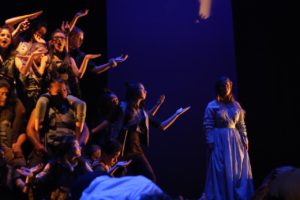
The first two plays, The Ragged and Dog & Bone, are the most text heavy. The Ragged is set in 1840 and introduces us to the people who become the family whose fortunes we follow throughout the plays. The first settler ships have arrived and are looking to settle. However the land promised to them is already occupied by local Māori. The play clearly delineates between the Māori and Pākehā worlds at that time and dynamically shows the differing opinions of those who lived in them. Terrible actions are taken with the corresponding utu matching that horror. Strong performances from Matthew Dussler, Jim Moriarty, Kimberley Skipper, Jeremy Davis and Noel Hayvice anchor the wide ranging story while Tamati Moriarty and Hariata Moriarty are the impact players in this piece. Dog & Bone is set in 1869 and focuses on the New Zealand Wars and the impact it had on families. Two brothers are on opposite sides of the war. One has joined Ngāti Ruanui in Taranaki to fight British troops; the other is a scout for those troops. This play is also where Pearse-Otene starts to introduce layers of reality into the series. Solid performances from the main family – Manuel Solomon, Reuben Butler, Greer Phillips, Ralph Johnson, Matthew Dussler – are matched by their visitors – Isobel Mebus, Unity Brown, Hariata Moriarty, Mearn Houston, Louis Tait, Dylan Fa’atui. Nova Waretini-Hewison and Mila Moriarty give an astonishingly unified performance as a single character. The chorus play Ngati Irawaru and every time they appear (after the initial scene) they are electrifying. They also wear my favourite costumes in the series. (Costume designer Cara Waretini and Costume assistant Elysia Ellis have done a really good job on costuming not only in the number but also for the coherence of the design.)
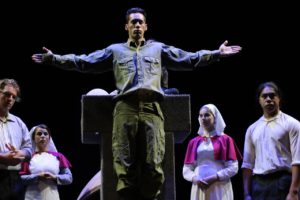
The third and fourth plays, Public Works and The Landeaters, are more abstract, and play with ideas of reality, memory, connection, and relationship. Lighting and sound design are outstanding in these two plays. (Lighting designer Lisa Maule, lighting operator Giovanni Maule; Sound design Busby Pearse-Otene, sound operator Helen Pearse-Otene.) Public Works brings us to 1917 and Passchendaele, Belgium. It focuses on three main characters who seem to be trapped in a no-man’s‑land which sometimes unhooks from reality. Reuben Butler, Manuel Solomon and Greer Phillips give great performances in this somewhat complicated story. (I have to confess this is my favourite of all the shows for its sheer boldness in script and staging.) The final play, The Landeaters is set ‘the day after tomorrow’ and draws on threads from the previous plays. The homestead is being torn down to make way for development and Vietnam War veteran Harry has decided to dig in, in protest. Ralph Johnson is brilliant in the main role with Matthew Dussler bearing the brunt of his tomfoolery. They have a nice rapport together. Kimberley Skipper is exuberant, with Nicole Ashton, Mearn Houston, and John Ulu strong in their characters. The chorus are once again excellent.

There are many things I love about The Undertow. It features a cast and crew that are multigenerational. It uses te reo Māori and English. It’s ambitious in both script and theatrical style. There’s singing and dancing and it feels integrated. It tells a story that is of this place. However, it’s by no means perfect. The accents can be dodgy. The nature of the performance space means that lines are often shouted and inexperienced actors sometimes struggle to show the nuance of their characters. The acting can seem artificial as actors must face the audience to deliver their lines or risk having them disappear into the roof. In spite of that I recommend that you see it – preferably in marathon on Saturdays during the season. Whichever way you choose to see it remember to eat and drink before you go (Te Papa doesn’t have a snack or drinks bar*) and to take something warm in case the air-conditioning goes arctic like it did on opening night.
This is an important theatrical event that is also incredibly entertaining. Ngā mihinui ki te whānau a Te Rākau Theatre.
- The Undertow, on at Soundings Theatre to Sunday 29 January 2017
* If you see the double bills during the week you’ll have 30–45 mins between shows which is enough time to exit the museum and purchase a drink and/or snack from the theatre across the forecourt. You won’t be allowed to take any food or drink other than water into Soundings so you’ll have to consume it before you go back.
Content warning after the jump.
At the theatre awards last year James Nokise challenged theatre makers to tell our stories. In one of the audience feedback sessions Jim Moriarty referred to our ‘cultural amnesia’ and said “Let’s keep on having conversations about our past.” This means the script doesn’t shy away from the following: racism, murder, cannibalism, child abuse, war, PTSD. It’s one of the reasons I’m recommending the marathon – I think the series works better with each play to give the next one context.
Thanks for the review. Going to see 3 & 4 tonight. Appreciated the comments about the break and how cold it can be.
saw 1&2 last night, AMAZING!