New at the Movies: Star Trek Into Darkness, Song for Marion, Gambit, Spring Breakers and Maori Boy Genius
 The 2009 Star Trek reboot went into production on the eve of the writers’ strike and therefore had no right to be as entertaining – or to make as much sense – as it did. In fact, it was so successful that it has become the gold standard of dormant franchise resuscitation and I’m hoping that the lessons – what to honour, what to ignore, the mix of knowing humour and state-of-the-art action – are taken on board by the forthcoming Superman blockbuster Man of Steel.
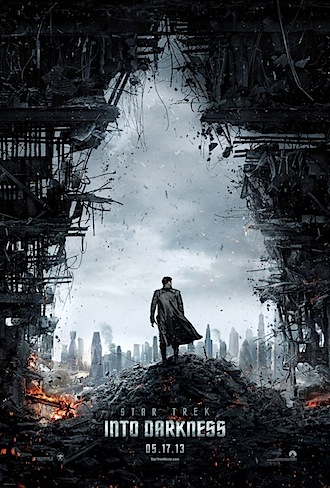 A re-watch of Star Trek on Wednesday night confirmed my thoughts from the original review. It worked so well, on so many levels, that by the end I was eagerly anticipating my Friday night reunion with Christopher Pine’s Kirk, Zachary Quinto’s Hot Spock, etc. So, it is with a heavy heart then, that I have to report feeling let down by Star Trek Into Darkness. Everything seems a lot more self-conscious than before, as if the filmmakers have just realised that there are a squillion people watching and they’d better not make a mess of things. Which usually means that’s exactly what happens.
Not long after the Federation has been saved in the first film, our heroes are out exploring the galaxy, getting into trouble. As punishment for violating the Prime Directive (and incomplete paperwork), Kirk is relived of the Enterprise command but before he has time to properly lick his wounds, a terrorist bombs Starfleet’s London office and threatens to kick off an intergalactic (intra-galactic?) war with the Klingons.
[pullquote]dying is easy – comedy is hard[/pullquote]It’s the execution that disappoints this time around. The humour feels a bit heavy-handed, the attempts to incorporate beloved elements from the Original Series are clunky and the action is repetitive – there are several last second rescues, for example, and at least two of them involve actual on-screen countdowns. I can’t say more for fear of spoilers but – suffice to say – Star Trek Into Darkness is only a B minus while its predecessor merited an A.
I also don’t get the fuss over Benedict Cumberbatch, but more about that another day.
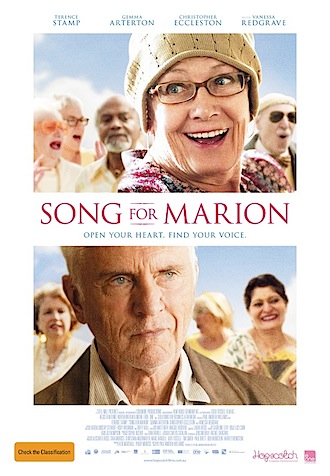 Song for Marion opens with one of the ten best songs ever written – Charlie Rich’s “The Most Beautiful Girl (In the World)” – so puts multiple brownie points in the bank before a line is spoken. Terence Stamp plays taciturn Arthur, grudgingly escorting his ailing wife Marion (Vanessa Redgrave) from their modest bungalow to the hall on the local estate so she can sing with her mates while he sullenly smokes outside.
Marion’s choir is organised and led by a perky young schoolteacher (Gemma Arterton) and she is determined for them to enter a local competition. Arthur is worried that Marion’s health is not up to the extra work involved and when his fears are realised he withdraws even further into himself, to the extent of alienating his own son (the always welcome presence of Christopher Eccleston) and granddaughter.
But this is a feel-good – uplifting – movie, not something by Michael Haneke, so the pleasures are to be had in the turnaround. Song for Marion could not exist without the brilliant documentary about a pensioners’ choir, Young @ Heart , which dissolved me into a puddle on the floor of the Embassy back in 2007. It milks the inevitable humour less successfully but hits the sentimental target, helped by Stamp’s vanity-free performance and Redgrave’s warmth. Viewers of a sensitive disposition are warned to vacate the cinema before Celine Dion starts warbling over the closing credits.
 Marion and Arthur may argue otherwise but it’s a universal truth that “dying is easy – comedy is hard”. This is the main lesson that Colin Firth can take from the caper movie Gambit in which he plays a frustrated art historian trying to defraud his boorish employer by means of a forged Monet and a beautiful Texan chicken plucker. It’s very rare to see a film with such promising individual contributors (a script by the Coen Brothers for starters, Alan Rickman as the media tycoon, Cameron Diaz as a not-so-dumb blonde) fail to click to quite this degree but here we are.
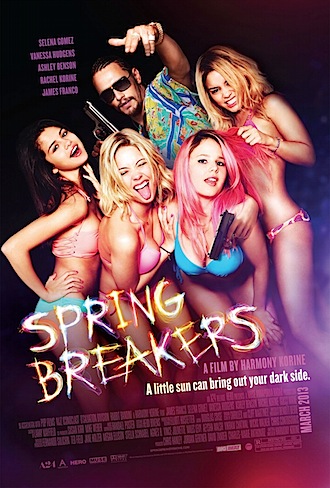 Harmony Korine’s Spring Breakers arrives on our shores with quite a reputation for all sorts of cultural and social transgressions, but I found it to be an old-fashioned morality tale dressed (scantily) in music video apparel. It’s the clash between what actually happens to the characters and how their story is presented that makes Spring Breakers both interesting and at the same time fairly repulsive.
Four teenage girls (Selena Gomez, Vanessa Hudgens, Ashley Benson, Rachel Korine), desperate to join their friends on the Florida beaches for Spring Break, rob a diner, torch a car and blow the takings on blow before getting busted by the local cops. Feeling a tiny bit sorry for themselves at this point – but not sorry for anyone else – they are bailed out by bejewelled playa James Franco who introduces them to a genuinely criminal underworld.
It’s one of the interesting things about cinema – that the camera can make glorious the ugly and profane but also turn beauty into something foul, sometimes just by making us conscious of our own gaze. Spring Breakers spends a great deal of time objectifying pretty drunken girls on beaches, but the narrative also punishes the transgressors in quite traditional ways. I think what I’m saying is this – Spring Breakers is more interesting as a cultural artefact than it is as a movie.
 The marvellous documentary Maori Boy Genius was one of my picks of 2012 and I’m pleased to note that it is now getting a decent cinema release so more people can be exposed to the charming young New Zealander Ngaa Rauuira Pumanawawhiti. Only 16 during filming, Ngaa Rauuira shows great promise as a scholar and a leader and Pietra Brettkelly’s film follows him as he takes on the immense challenge of studying international politics at Yale University. This is only the beginning for a fascinating young man.
[Cross-posted to Funerals & Snakes]