The enlightened solution
In what you might choose to view as a coincidence, the cities of Auckland and Wellington are both engaged in a fight to eradicate street begging. Not homelessness or poverty, mind you: just begging. Auckland will likely vote later this year on an outright ban. Wellington, the more genteel capital, has opted for a measure that it has christened ‘alternative giving’, whereby citizens will be encouraged to donate to organizations who work with the homeless instead of the beggars themselves. Of the two initiatives, I find this one to be the most odious.
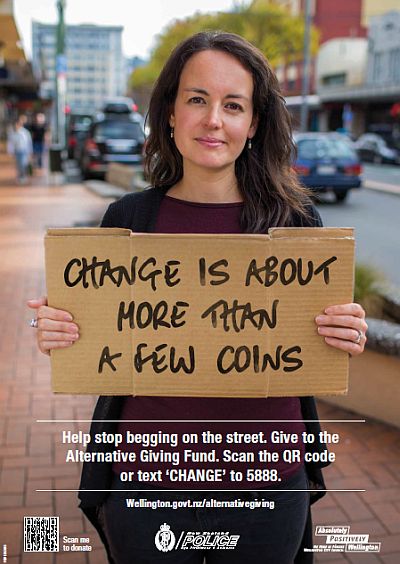
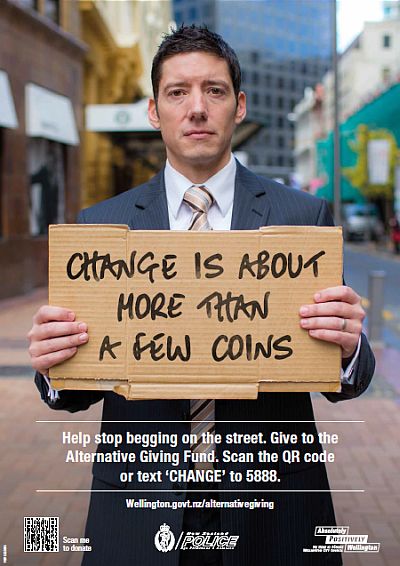
The Alternative Giving campaign relies primarily on two pieces of technology: in the initial phase, a series of posters like the one above are designed spread the message amongst the public. The posters feature a QR Code allowing smartphone users to make an instant donation, with the amount to be split evenly amongst the six participating charities. In the second phase, which is yet to be implemented, a series of “charity boxes” will be installed in begging hotspots, so that people can physically redirect the spare change they were about to give to the beggar, and put it to an economically more rational use. This is the image that is stuck in my head: that of a person begging for money, and of a passer-by reaching for his or her pocket, then putting the money inside the box instead of giving it to them. Will glances be exchanged? Will the look on the face of the alternative giver say: ‘I’m doing this for your own good’? Or will in fact the gesture be accompanied by a little homily? ‘You might spend this money on booze. I’m giving it to the box.’
Alternative Giving is the liberal answer to the problem of begging. Supported by the Green mayor, Celia Wade-Brown, and administered by former Alliance Councillor Stephanie Cook (this is the pair who blamed the neighbours of Michael Clarke for being insufficiently neighbourly), the initiative has been compared favourably to the Auckland ban, both by Cook herself (who called it a ‘less harsh’ and ‘much more compassionate and pragmatic option’) and by Diane Robertson of Auckland City Mission, sister organization to one of the recipients of the Wellington campaign. Criticism of Alternative Giving has also been generally less harsh, with no-one venturing to match Councillor Cathy Casey’s accusation that the proposed Auckland bylaw ‘treats beggars like dogs’.
Since Alternative Giving is the liberal answer to the problem of begging, its backers have to resort to a far greater degree of equivocation. The Auckland advocates – bless their black, black hearts – seem largely unperturbed that the bulk of the submissions they received came from retailers who wish to quite literally be allowed to sweep poor people away. In the more cultured, more enlightened Wellington, it is necessary for the goal to appease business owners to be carefully dissimulated. Thus begging is presented as the problem, but why or how it’s left studiously vague. The Mayor said that ‘it’s not good for anyone to have a significant number of beggars on the streets’, elegantly glossing over the issue of whether people needing to beg in the first place might be a bad thing, and for whom. A council spokesbeing lamented that people in an actual state of need stand to gain too much due to the generosity of Wellingtonians, estimating that they can accumulate (as opposed to earn, for words do matter) as much as $100 a day. Why this is a bad thing, however, he left unsaid. Some noises were also made about beggars possibly misspending the funds to buy ‘alcohol or drugs’, as if these were straightforward causes, as opposed to symptoms, of their economic distress. Or as if poor people shouldn’t be allowed some of those middle class vices. For their part, central city retailers approached by the Dominion Post ‘reported an increase in begging overall, often among people who did not appear homeless or in obvious desperate need’, as if their beef wasn’t with ‘real’ beggars, but just the opportunist pretenders (which apparently they can spot by their ‘tailored cigarettes and expensive energy drinks’. And no, I’m not making this up).

As for the effects of the policy, Councillor Cook suggested that ‘[t]hose who are currently perhaps ‘opportunist’ beggars if you like, will gradually disappear because they’re not getting a result.’ Why the genuine beggars won’t be similarly deterred, or deterred less, I couldn’t tell you. Perhaps Alternative Giving is like one of those intelligent bombs that never hit civilian targets. The statement however reveals the campaign for what it is: an instrument not to address homelessness and poverty but to hide the homeless and the poor. To make them ‘gradually disappear’. How you do that is not by donating to organizations that will help them out (that particular money will never be enough to go around, and besides it could be solicited in other ways), but by reducing their income from street begging. That is the sole point of the campaign, and the reason why it is so much more loathsome than its Auckland counterpart: because it dresses up as piety and turns into a desirable social goal the community’s desire to remove its poorest members from sight.
This ethics of not giving is persecutory and evil, and must be opposed. But it’s also important to recognise that the effort to sanitise the streets – which on the surface is nothing more than another exercise in capitalism keeping up appearances during a downturn – is also a form of control. And no, I’m not saying this just because this ostensible social programme happens to be co-sponsored by none other than the New Zealand Police. It is the same paternalistic logic that governs the national programmes of welfare reform. It is the insistence that we must be cruel only to be kind; that we must punish the weak so they can become strong. As if this wasn’t deep down about enforcing a failing economic and social model by correcting the subjects that fail to conform to it. This is how we care now. Look at it. This is who we are.
I don’t entirely agree with the idea of putting in cash boxes where people beg, but I do support encouraging people to give to organisations like Downtown Community Ministry and making that easier. I currently do not give to beggars who I don’t personally know (I do know a fair number because they sleep in an area of public land I am restoring), because I can’t tell what good that would do. I’ve dealt with enough who have serious addiction problems to know that giving them money isn’t necessarily helpful. And I’ve had enough dealings with the agencies and their clients to know that access to good agencies is more helpful than a small amount of cash. Because they don’t just give money — they give broader support (e.g. mental health assistance, banking services, budgeting services, help to find housing).
I also disagree that supporting the agencies would make the poor and homeless less visible. They don’t go away just because they aren’t begging, and the agencies help make them more visible. It’s pushing them out of public places that would make them less visible. Which Auckland has been doing.
So I do prefer Wellington’s approach.
It’s quite easy to hack those QR codes with a little sticker that points to a website with an alternative point of view.
This campaign has just reminded me to give more to buskers… they may be next on the list of “undesirables”!
This may turn into a rant for which I apologise
The thought of channeling the money that one would give to beggars has always appealed to me. When I was in San Francisco recently I found an alternative food bank and gave them $20 bucks as I knew the food wasn’t going to go to booze or drugs.
The opportunists exist and you can spot them, there was a bunch who used to live in the top of my building, someone’s affluent father paid the rent. There would be days when I would see them begging for money (often being rude and aggressive) there is the group who have taken over blanket man’s spot who fits the build.
Blanket man is a great example of beggar who was loved by many, and ultimately enabled by people who gave him money. There were weeks where he would earn in excess of $1500 (someone watched one weekend and did the sums) what a difference that money could have mad across a charity.
Yes, there is a wider social problem that needs to be addressed. Yes we need to acknowledge that there are those less fortunate. But when see a group of people (not necessaryily homeless) planning their hustle (Actual quote) I think there is a better way to help.
I prefer to give straight to a charity as $3 at the city mission goes further than $2 in a hat. (Tax deductible donations)
“Blanket man is a great example of beggar who was loved by many, and ultimately enabled by people who gave him money.”
Enabled him to do what? Live on the street?
“There were weeks where he would earn in excess of $1500 (someone watched one weekend and did the sums) what a difference that money could have mad across a charity.”
Charities could use more money. But why does it need to be the street beggars’ money? If you’d rather give $3 to the City Mission, then give $3 to the City Mission. Why does the money have to come out of a beggar’s pocket? What is exactly the relationship between those two donations?
When I give moey to a beggar, I don’t do it to alleviate, much less solve, the problem of homelessness or poverty. I do it because a human being asked me for it. It doesn’t come out of a budget I have for charitable donations. (I doubt anyone keeps such a budget to be honest.) So redirecting it isn’t any more logical than redirecting the money I might have spent on a chocolate bar at the dairy, or a trip to the cinema. Except — and I really can’t get past this — is campaign is humiliating for street people. The charity box idea if obscene. If you were holding your hand out in the street, which god knows must be hard enough to do, how would you feel if someone put a box next to you? How would you feel if someone used it, instead of giving to you, who are right there, because they don’t trust that you will spend their meagre change wisely? (And we could get into a long discussion of what is “wise”, by the way.)
And shall we get into the cost of this ridiculous campaign? Why don’t we give _that_ money to charity, by this logic?
I’m reminded by the street-beggars of Hong Kong that having beggars is not a compulsory feature of big cities. As far as I can tell, there are no street beggars there, despite the incredibly dense population. It is, perhaps, the most capitalistic nation on earth. Some pertinent facts: there is no income tax, so what you earn, you keep. There is also no social welfare net, so you have to look out for yourself. No one begs, everyone works, bloody hard. I’ve seen men occupying a space between two buildings,mand making it into a shoe repair shop, raking out a living, because he knows that if he doesnt, then he won’t survive.
And I think that is the thing that rankles in NZ, when people beg. Asking for money, for doing nothing. My reaction, the same no doubt as for many, is: Get a Job. Anything, something, but don’t just sit there. Make your own way in the world. If you can’t, then my taxes pay you a social welfare benefit, and you should be able to survive on that, but don’t ask me for more for just sitting there doing nothing. It is one of the reasons I, and other people, had more respect for Ben Hana than for other street people. He never ever asked for money. He looked surprised if you offered to give him some. He turned down my $20, so I find the likelihood of getting $1500 highly unlikely. The opposite end of the spectrum from Mr and Mrs “Excuse-me” who regularly ply the streets, with a plaintive cry of Excuse Me, who work long hours in return for their begging.
You know that in order to get a benefit you have to have a bank account and in order to have a bank account you need to have an address, right? And in order to have a job you need to have a phone and basic literacy skills etc?
For some reason, this article has been sitting in my RSS feed for a while. I finally read it today and I want to thank you for the long rant. Here are a couple of my thoughts:
1) As an immigrant from a capitalist country, I thought that NZ had a good social net. What the Wellington Mayor and/or Council have not addressed is WHY there are people on the street begging. Have they fallen through the cracks? Do they not want to partake in the safety nets that are there? Will additional funds and resources funneled to the City Mission et al actually help THESE particular people?
2) If you give money to someone on the street, you don’t get to determine what they do with it. If you want to control that, don’t give them money.
3) I read a story from a homeless person who described sitting in front of a grocery store asking for change so that he could buy a toothbrush. Instead, people kept giving him sandwiches. Remember that those with limited resources still need things like toothpaste, combs, deo, tampons etc. If you’d rather buy a Warehouse gift card and hand that out — do it.
I won’t be giving to the boxes.