Review: The Human Voice (La Voix Humaine; NZO season)
TW: Suicide, overdose, trauma
I reviewed a production of La Voix Humaine in February. It’s been a strange wormhole of a year and it feels like a million years ago but also maybe yesterday that I was sitting in Suite Gallery, experiencing this piece for the first time. Writing this review with the last one so fresh in my mind despite ten months between them, it would be easy (lazy), to just draw comparisons between the two productions. It certainly would do a disservice to both. I guess there’s a balance to be struck, but I’ll try to write specifically about Thursday’s experience.
Thomas de Mallet Burgess is the general director of NZ Opera, and I heard him speak about his aspirations when the 2020 season was launched. 2020 marked the 20th anniversary of NZO as a national organisation, and while that was momentous, de Mallet Burgess acknowledged the challenge of bringing opera to an increasingly smaller audience, in an age where it’s not a widely appreciated genre. He talked about the onus to make opera accessible and exciting for a more diverse audience, and to provide opportunities for new artists and venues. This vision is one I can entirely support – opera as an institution is wonderful, but it needs to evolve and acknowledge the identities and narratives of Aotearoa as well as upholding the traditions of the past. Hear, hear!!!
And then came Covid.
The ability to once again congregate and experience art is a true joy, and we watch the rest of the world continue to fight (or claim to) the pandemic from a very privileged position in our #nzhellhole. We learned new ways to watch shows over lockdown, but it’s still a relief to do it in person and together.
The Human Voice is a one-act monodrama with one performer and one musician, composed by Poulenc in 1958. A little history can be found in my last review, if you’re interested, but, Spoilers.
The venue was the Ohtel, on Oriental Bay. I’ve often wondered what it was like inside, and can report that the suite was very comfortable, the bathroom was seriously delicious, and the staff were super lovely and professional.
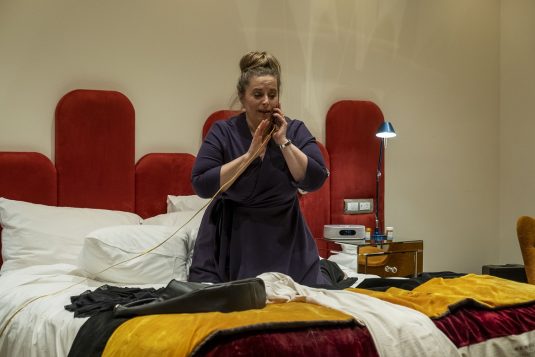
There were three rows of chairs for the small audience in the suite, probably where a couple of armchairs and a small table would normally be by the window. The bed was large, there were cute knickknacks on built-in shelves, and the lighting was moody once the glaring spots were turned off.
Hiding behind the bathroom curtain was a keyboard, played by music director David Kelly with sensitivity and perfect timing. No small accomplishment, considering he couldn’t see his singer and is presumably used to a bigass grand piano.
Amanda Atlas is an impressive dramatic performer, with a rich and powerful soprano voice. Somehow all that charisma and vocal force was compressed into a smaller, more brittle woman, Elle (She), as she weathers one last phone conversation with the lover who has left her. The Human Voice follows Elle as she waits for that phonecall, and along the complex emotional path the conversation takes.
It was quite incredible to know what Amanda Atlas is capable of vocally, and to see it restrained inside the character, only bursting out occasionally when Elle’s reactions could not be contained. It’s no mean feat to maintain depth and pitch and tone and feeling at a low volume, while curled up on a bed, instead of belting freely into a huge theatre. Brava! And Atlas’ performance of Elle’s journey through self-delusion and anguish, trying to maintain the impression of “coping” and even flirting with the guy who’s CLEARLY lying like a dead dog, is quite the trip.
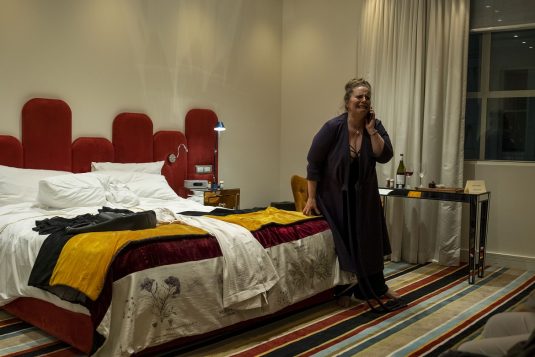
This is where I can’t help but compare this production to the one in February. De Mallet Burgess chose to direct this piece as an epitaph. Elle gives up, drinks the wine, takes the pills, and gently fades out at the end. She might wake up tomorrow maybe, but her intent not to is clear. Her journey is a slide into despair, and her side of the conversation is submissive and solicitous. I want to punch her narcissistic ex just for making her apologise and take the blame when she’s clearly the victim. SHAME.
February’s production gave me an Elle with strength as well as fragility, the potential to heal from the relationship, and some moments of lovely sarcasm and rage. Sure, there could absolutely be another suicide attempt, but there could also be a far brighter future for her. Those extra emotional layers allowed for a greater vocal range, too.
The differences come down to choices made by the directors (and one would hope, the performers as well), and de Mallet Burgess chose to direct a swansong. So it was sad, and it was upsetting, and it was hard to watch. That’s good; art should make you feel things, and I definitely did.
De Mallet Burgess also directed Eight Songs For A Mad King in March, and it’s fantastic that these dynamic modern productions are being staged, with their challenging subject matter and messy emotions, as well as the beloved old standards.
The Human Voice is sold out for the rest of the Wellington Season, but there are two shows in Taupo on November 5th, and six in Auckland, from November 10–12. Book here if you can make one!